Private, secure model adaptation for LLMs and vision systems: LoRA, QLoRA, YOLOv8 custom training, evaluation, registry, and edge export through ONNX, TensorRT, and OpenVINO.
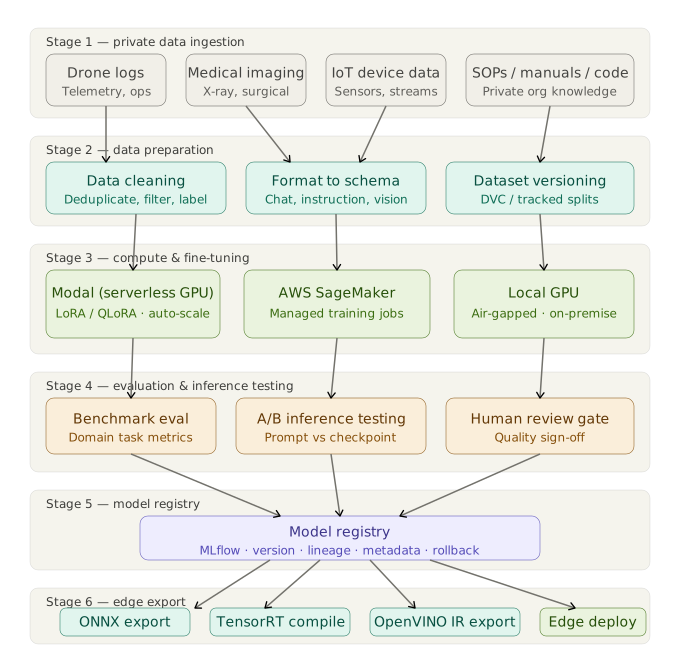
Forge LLM connects private dataset ingestion, model training, evaluation, registry workflows, and deployment bundles so domain models can be safely improved and shipped into operational environments.
Trains low-rank adapters while base weights remain frozen, giving strong domain adaptation with fewer trainable parameters.
Uses 4-bit NF4 base quantization plus adapters to tune larger models under constrained GPU budgets.
Updates all weights for specialized domains when adapter accuracy is not sufficient.
Trains custom detection models and exports ONNX/TensorRT/OpenVINO-ready weights.
Fine-tune on telemetry logs, maintenance SOPs, flight manuals, and incidents so Cognex RAG understands fault codes, mission profiles, and battery patterns.
YOLOv8 training on private imaging datasets for anomaly detection and edge deployment without data leaving controlled infrastructure.
QLoRA fine-tuning on procedure transcripts, instrument catalogs, and documentation for multimodal clinical workflows.
Train vision models to detect correct mounting, cable routing, damage, and tamper indicators on installed IoT devices.
Adapt models to work orders, part numbers, failure modes, inspection reports, and regulatory language.
Train YOLOv8n/s on organization-specific assets, quantize to INT8, and deploy to Jetson or Intel edge targets.
Full fine-tunes can overfit domain data and lose instruction-following skill. Forge mixes domain data with general instruction samples and uses early-stopping eval gates.
For healthcare data sovereignty, Forge supports air-gapped local GPU runs with audit logging, dataset version tracking, and model checksum records.
Safety-critical tasks may require NF4 for the model bulk but FP16 retained on final classification layers, plus A/B evaluation against LoRA baselines.
Forge runs pre-export operator audits and post-export tolerance validation to catch PyTorch-to-ONNX and TensorRT compilation issues.
Modal, SageMaker, and local GPUs can differ subtly. Forge pins containers, captures environment fingerprints, and validates outputs within tolerance.
Low-data domains use grounded synthetic instruction pairs, paraphrase augmentation, and conservative LoRA ranks to reduce memorization.
Transformers, PEFT adapters, bitsandbytes NF4 quantization, and TRL SFTTrainer for instruction-format training.
Adapter ranks tuned per task, QLoRA for 34B+ models, mixed precision gates for safety-critical classification.
Custom object classes, COCO-format datasets, auto-augmentation, ONNX export, TensorRT and OpenVINO compilation.
A100/H100 jobs with pinned containers, spot options, environment fingerprinting, and zero idle GPU cost.
VPC isolation, IAM-scoped access, CloudTrail audit logging, and multi-GPU training jobs for enterprise runs.
On-premise containerized training for healthcare, defense, and sovereignty-sensitive datasets.
Tracks hyperparameters, loss curves, eval metrics, dataset hashes, environment fingerprints, and promotion gates.
Primary model export with operator audits and PyTorch-vs-ONNX validation before runtime compilation.
INT8 calibration, IR compilation, runtime configs, model cards, and versioned edge deployment bundles.