Diagrams
RETRIEVE, REASON,
AND ACT.
System Architecture
Retrieval Pipeline
MCP Tool Layer
A grounded AI copilot for edge, IoT, and autonomous systems that combines live telemetry, manuals, SOPs, incident history, chat, voice, citations, and MCP-powered actions.
Cognex RAG turns fragmented operational data into one intelligent interface. Operators can ask natural-language or voice questions, retrieve cited context from documents and telemetry, and execute tool-backed workflows through MCP servers.
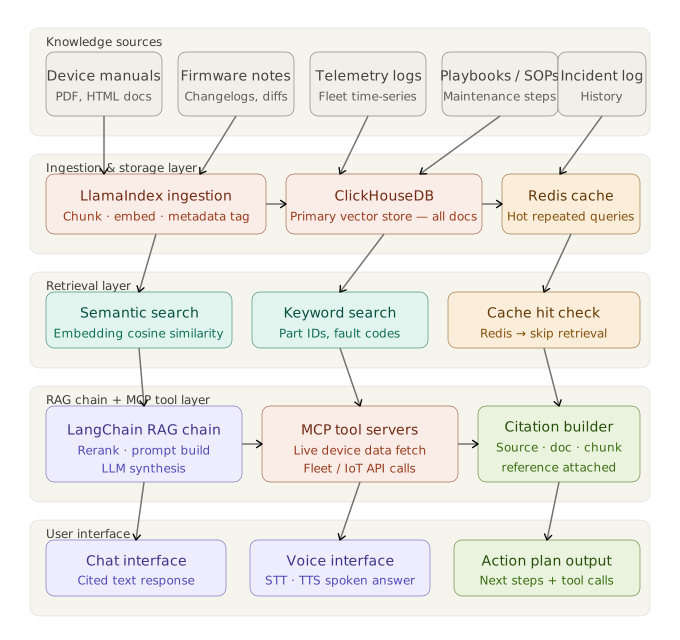
Manuals, firmware notes, telemetry, playbooks, SOPs, incident history, cloud logs, drone events, and edge AI outputs.
Semantic chunking, fixed telemetry summaries, metadata tagging, embedding generation, and low-information fragment filtering.
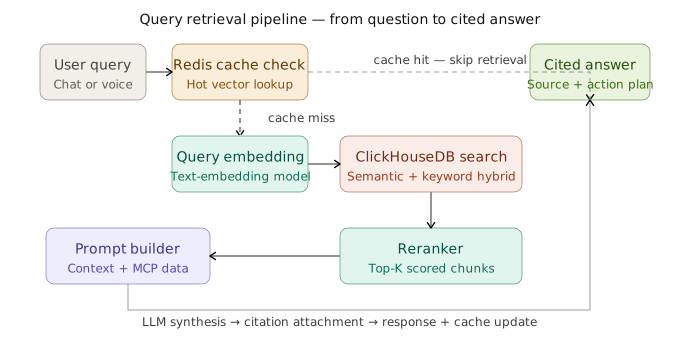
ClickHouseDB vector search combines with BM25-style keyword scoring and Redis cache checks for fast, relevant retrieval.
Top candidates are reranked before prompt assembly, and low-confidence chunks are marked or excluded from citations.
Field operators can ask typed or spoken questions and receive concise, cited answers through streaming interfaces.
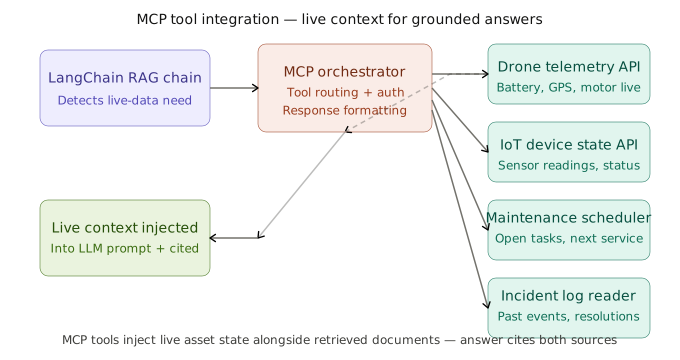
MCP servers fetch live drone telemetry, IoT device state, maintenance schedules, and incident logs when documents are not enough.
A field engineer asks about a fault code. Cognex retrieves the manual section, calls live telemetry through MCP, and returns a cited diagnostic action plan.
A technician asks for a battery replacement procedure by voice and receives a concise spoken answer from the relevant SOP.
Operations managers ask which assets are overdue for inspection, combining playbook rules with live scheduler data.
Engineers can ask what changed in a firmware release and whether the current fleet is running it.
Operators can describe a problem in plain language without knowing the exact SOP name or fault code.
Repeated high-traffic incident queries hit cache after the first retrieval, reducing ClickHouseDB load during operational spikes.
Large embedding tables can degrade under simultaneous queries. Cognex uses usearch ANN tuning, partition-aware routing, and Redis shielding during spikes.
Every sentence must trace to a retrieved chunk ID before returning. Uncited sentences are flagged or dropped during post-generation verification.
Retrieval and live MCP calls run speculatively in parallel so spoken answers stay responsive when live drone or IoT APIs are involved.
Recent telemetry is queried live through MCP, medium-term data becomes daily digest chunks, and historical data is fully embedded for trend analysis.
Fault codes and part numbers need keyword weight, while incident history benefits from semantic matching. Cognex tunes scoring by document type.
Domain glossary injection improves recognition for terms like YOLOv8, TensorRT, OpenVINO, fault codes, and firmware versions.
Stores manuals, playbooks, SOPs, firmware notes, incident history, and telemetry summaries with usearch ANN indexing.
TTL-based cache for repeated high-frequency queries using query-hash keys and serialized top-K chunk lists.
Loads, chunks, tags, embeds, and filters operational documents before indexing.
Coordinates query routing, hybrid fusion, reranking, MCP decisions, prompt assembly, and citation post-processing.
Standardized tool access for drone telemetry, IoT device state, maintenance scheduling, and incident log reading.
Semantic embeddings with Matryoshka dimension reduction for storage efficiency in ClickHouseDB.
Cross-encoder reranking over hybrid search candidates with score-based citation confidence gating.
Speech-to-text and spoken response synthesis with domain vocabulary support for technical field terms.
REST chat endpoints, streaming responses, voice progress events, Redis pub/sub invalidation, and Kubernetes scaling.