Diagrams
DATA FLOW
TO DECISION.
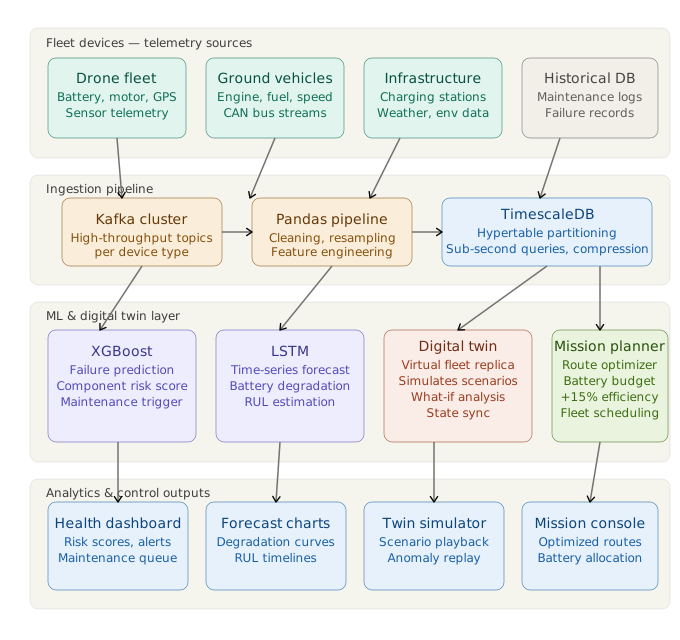
FleetSim Architecture
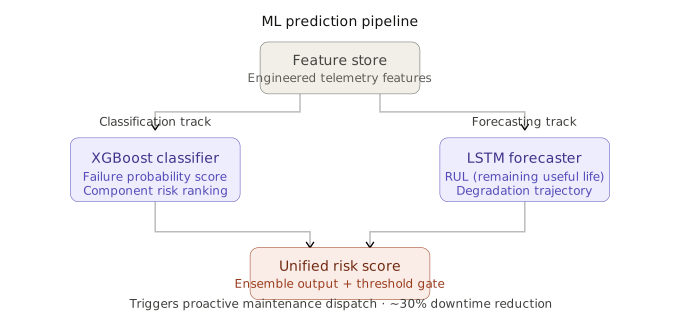
ML Prediction Pipeline
ML-powered fleet health, time-series forecasting, digital twin simulation, and mission optimization for drones, ground vehicles, charging infrastructure, and distributed assets.
FleetSim turns telemetry into maintenance risk, battery forecasts, route plans, and digital twin simulations that help operators act before assets fail in the field.
XGBoost models score component failure probability and trigger maintenance before operational failure.
LSTM networks ingest multi-month battery cycles to forecast remaining useful life and optimize swap or charge schedules.
A live twin mirrors fleet state and lets operators test routes, payloads, weather, and mission plans before committing assets.
Route optimization accounts for state of charge, wind vectors, payload weight, and historical energy maps.
Time-series deviation monitoring flags sensors and components outside their learned normal envelope.
The prediction, twin, and optimization stack generalizes from drones to vehicles and other telemetry-rich assets.
Battery efficiency levers include route optimization, wind compensation, speed profile tuning, and payload balancing. These combine into mission range improvements and lower idle battery loss.
Real failures are often less than 1% of records. FleetSim uses SMOTE, class weighting, and F1-focused threshold calibration rather than raw accuracy.
Device generations change sensor names and sampling rates. Schema registry, backward-compatible deserialization, and drift alerts protect pipelines.
Long sequences can destabilize LSTMs. FleetSim uses sequence chunking, gradient clipping, and LSTM + attention for long-range dependencies.
High-frequency fleet telemetry requires hypertable tuning, compression policies, and read-replica separation for sub-second query SLAs.
Network jitter requires timestamped state patches, conflict resolution, and heartbeat-driven reconciliation cycles.
Energy models trained in one environment need geospatial features, climate stratification, and local mission fine-tuning.
Failure classification with SHAP explainability, Optuna tuning, model versioning, and FastAPI inference.
Remaining useful life forecasting over sliding-window sequences with ONNX export and rolling retraining.
Multi-topic telemetry ingestion with schema contracts, consumer groups, and critical-stream semantics.
Resampling, rolling statistics, lag features, anomaly flags, and vectorized batch transforms.
Hypertables, continuous aggregates, compression, and fast queries over high-frequency telemetry.
Battery-aware routing and mission planning under energy, payload, wind, and asset-priority constraints.